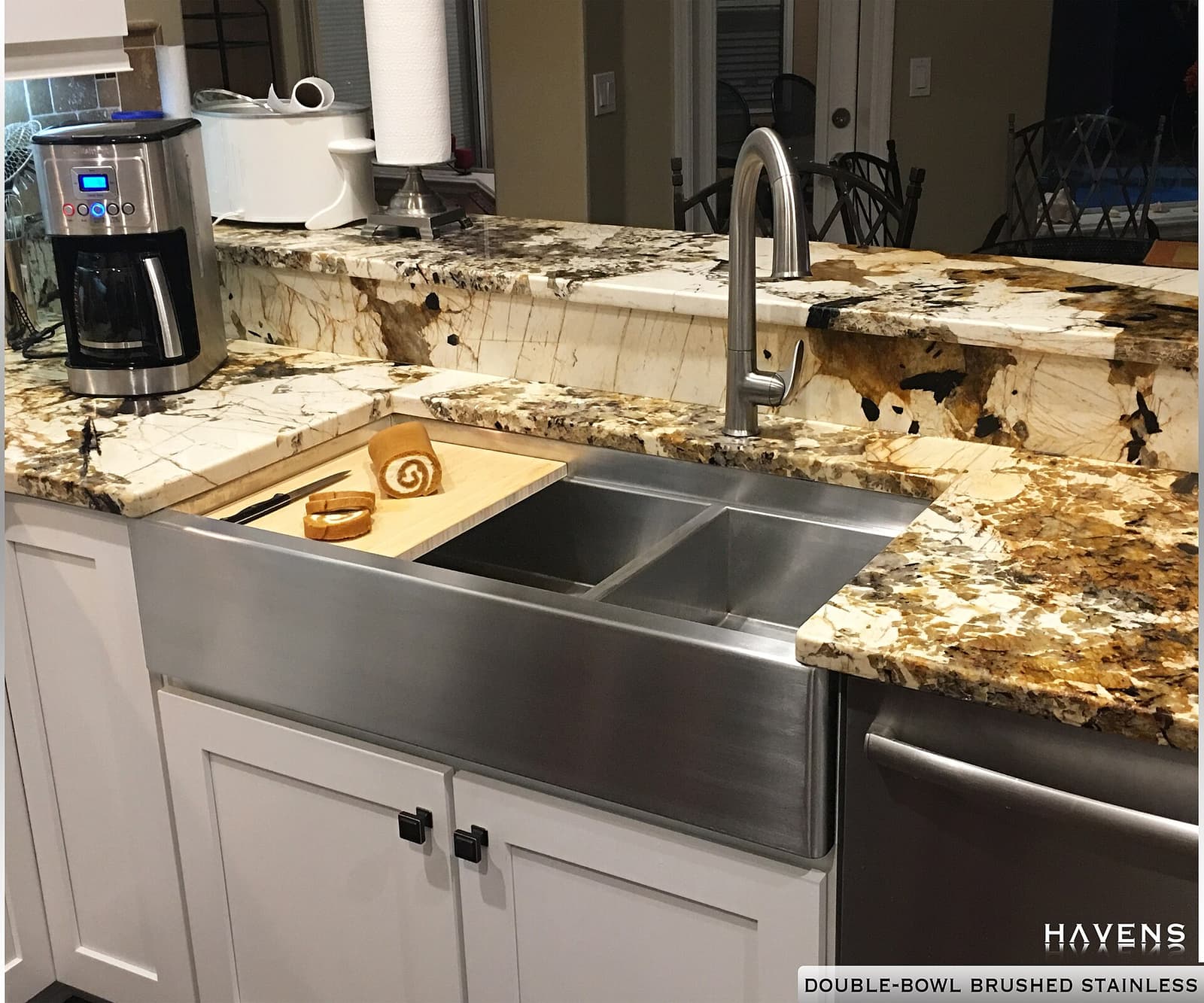

Most 304 that leaves an Australian merchant still becomes a bench. The old custom-cut catalogue knew this: sheet, folded edges, integral sinks if you paid for them, coving at the wall. The finish was No. 4 because fingerprints and pans are the job.
This is not a stone-versus-stainless lifestyle piece. It is a specification. Alltradestainlesssteel.com.au is a journal, not a merchant. We will not quote a live price. We will say how a top should be written so a fabricator, a cabinetmaker and a health inspector are looking at the same object.
A bench is a hygiene surface that also has to take a pot. Food-grade stainless is this use case, not a third stamp. FSANZ sets the Food Standards Code; states and councils enforce commercial rooms. None of them publish a magical thickness that replaces a rigid carcass and a wipeable upstand.
Alloy and finish
Indoor café and home: 304, No. 4, grain running the long way. Coastal outdoor kitchen: 316, and read outdoor cooking stainless. Food-grade language is a duty, not a brand.
Brushed versus polished is the client argument. Mirror tops photograph well and live badly. A No. 4 hides the first month of pans. A No. 8 shows every ring and every cloth mark. 2B belongs under a laminate or inside a cabinet, not as a café face unless you have a reason and a lighting plan.
When 316 is the bench alloy
Stay on 304 for indoor rooms that see ordinary detergent and tap water. Move to 316 when the top lives in brine, seafood, a harsh chlorinated wash-down, or an open kitchen that eats coastal air. 304 versus 316 is the chemistry essay. Paying for 316 to impress a landlord on an indoor café is how a fit-out budget disappears. Specifying 304 on a coastal balcony barbecue is how a top tea-stains before summer ends.
Ferritic 430 appears in some appliance skins. It is not your first choice for a welded wet bench. If a supplier says “stainless” and will not name a number, ask again.
Thickness and the box underneath
See the thickness chart. A 1.2 mm top on a 900 mm unsupported span is a drum. Stiffeners, a falling front edge, or thicker sheet fix it. Sound-deadening on the underside is allowed; it is not a substitute for structure.
Custom-cut edges should be folded, not left as a shear if a hip will find them. ±2 mm shows at a mitre; budget the dress.
Carcass, spans and oil-canning
The metal is only as quiet as the box. A hollow carcase with a thin skin oils-cans when you lean on it. That movement opens sink seals. Typical honest ranges:
| Duty | Alloy / finish | Thickness (typical) | What the carcass must do |
|---|---|---|---|
| Home or small café, rigid cabinets | 304 No. 4 | 1.2 mm if well supported | Close framing, no 900 mm hollow span |
| Wider prep, canteen abuse | 304 No. 4 | 1.5–2.0 mm | Stiffeners, falling front, sound-deadening optional |
| Coastal outdoor / poolside | 316 No. 4 | 1.5 mm and up | Drain, shade, A4 fixings, wash plan |
| Brine or chlorinated wash-down | 316 No. 4 | As the plant specifies | Hygienic welds, true coving, rinse discipline |
Timber cabinets are fine if they are rigid, if wet timber is not trapped against an unsized sink cut, and if the top can move a little with temperature. A stainless hat on raw particle board that never seals is a commercial kitchen fail waiting for a camera.
Fix through slots or clips, not a rigid screw pattern that fights a long expansion. A top that cannot move will oil-can on a west-facing window as surely as a thin lid will twist in the sun.
Sinks, taps, joints
An integrated sink is a fabrication. A drop-in sink is a hole and a seal. Both need fall to the waste. Timber carcasses need a plan for the cut-out. Tap holes in a splashback want reinforcing if the sheet is thin.
Do not silicone a structural joint and call it coving. Use actual coving or a folded upstand you can wipe.
Integrated versus drop-in
An integral bowl is welded or drawn into the top. It should drain, carry a continuous weld you can clean, and leave no dirt step at the rim. Heat tint belongs off before handover — passivation is part of the fabrication.
A drop-in bowl is faster and more replaceable. It is also a gasket. Gaskets fail when the top drums, the cut-out is ragged, or someone walks the seal. Size the hole. Support the rim. Keep wet timber from swelling into the cut.
Tap holes in thin splashbacks oval if the mixer is heavy and the sheet is 1.2 mm with no plate behind it. Specify a reinforcing plate. Services through a splash zone want the same discipline a commercial room uses: planned, sleeved, sealable.
Upstands, coving and the wipe test
A home kitchen can live with a folded upstand and a neat seal. A commercial room usually wants a radius you can wipe — floor cove, sometimes a bench cove, and no square silicone cave at the wall. That is hygiene detailing, not decoration. The kitchens and hygiene hub maps the food-side essays.
Run the grain the long way on the top and keep the upstand grain consistent if you can. A vertical splash with a horizontal top is normal; a patchwork of leftover blanks is how a short sheet announces itself.
Open screw threads in a splash zone are dirt traps. Prefer welded or capped details. If you must fasten through a wet face, place the head where a cloth can go around it and use the right stainless — A2 inland and indoor, A4 in wet coastal work. See A2 versus A4 fasteners.
Living with it
Clean without bleach. Peel film late but not after it bakes — protection during install. Hot pots mark; that is physics. If the client wanted invincible gloss, they wanted a different material and a different lie.
Film, cement and the first week
Leave the PVC on through the tiler and the painter. Cement splash and brick acid age a new top faster than a year of coffee. Mask it like joinery. When you peel, wash with a neutral detergent, dry, and photograph. Film hides the dent you still have to fix.
Daily chemistry
Neutral detergent, soft cloth, with the grain. Rinse if the product needs it. Dry if you can. Household bleach and chlorinated gel left to dry are chloride sources. They pit. They also produce the brown freckles people blame on the mill. Coastal and poolside tops pick up salt and fat together — coastal care is a hose and a schedule, not a coating.
Carbon-steel grill tools left wet on a 316 outdoor top print rust. That is contamination, not a failed alloy. Keep a stainless-only pad in the drawer and throw the steel wool out.
For canteens and plant, step up to commercial kitchen stainless requirements. For a bench that sits beside a pool fence or a marina, the pool and marine fittings essay starts to apply: 316, fall, no ponding, no bleach.
A specification sentence that works
Write the alloy, the finish, the thickness, the edge, the sink type, the upstand, and the room. Example: “304 No. 4, 1.5 mm, folded falling front, integral bowl with fall to waste, 100 mm coved upstand, grain long way, filmed, timber carcass rigid and ventilated, A4 fixings if the window is salt air.” That sentence is a product. “Stainless bench, good quality” is not.
The old Alltrade custom-cut habit — name the blank, the fold, the finish — is still the honest way to buy a top from whoever fabricates it. This journal will not fabricate it. It will tell you what to put on the order so the top can be washed and still look like 304 at the end of summer.