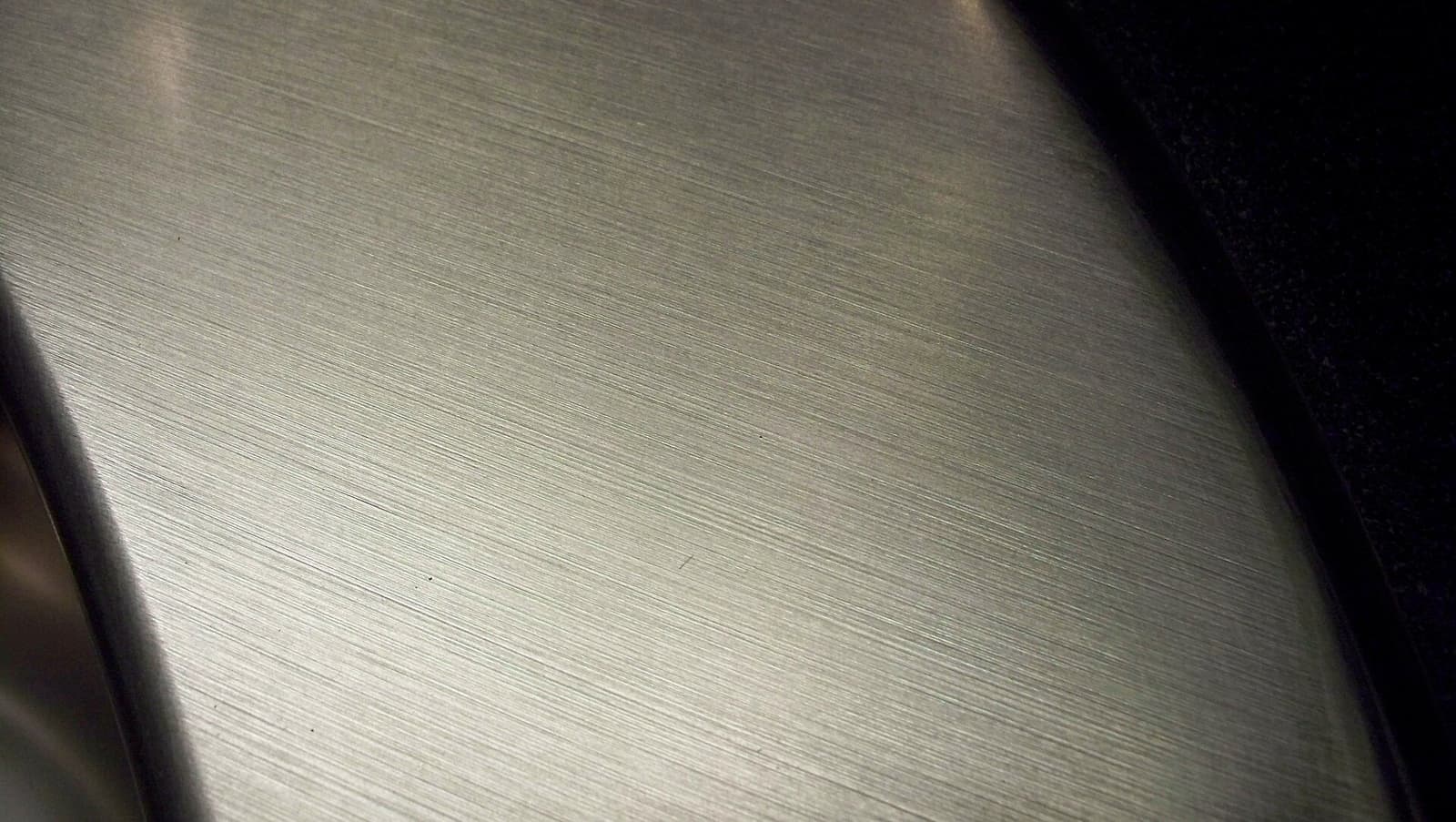

The archived Alltrade sheet page treated finish as a line item, not a vibe: No. 2B as the mill product, No. 4 as the brushed kitchen standard, No. 8 as the most reflective polish they sold, and bright annealed as a mirror-like sheet that still admits cloud. Heavy angles arrived in HRAP — hot-rolled, annealed and pickled — which is supposed to look dull.
Those names are still the ones Australian merchants print. If you only say “polished,” you will get whatever was on the rack. This journal is not a merchant. It still uses the old Melbourne catalogue language because trades still write purchase orders in it.
Finish is not grade. 304 versus 316 decides chlorides. Finish decides how light, dirt, fingerprints and scratching behave on the face you can see. A coastal No. 8 in 304 is two mistakes stacked. A kitchen 2B splashback photographs badly on handover day.
How mill finishes are made
Stainless sheet leaves the mill as a process, not a mood board. Cold-rolled coil is annealed, pickled, then given a light skin pass: that sequence is 2B. A controlled-atmosphere anneal that keeps the surface bright is BA. A later belt-brush is No. 4. Keep polishing until the grain disappears into a high reflection and you are heading for No. 8.
Hot-rolled plate and many heavy sections never see that cosmetic sequence. They are annealed and pickled and left dull: No. 1 or HRAP. That is not a failed polish. It is the honest face of a structural product.
Protective film is part of the finish conversation even though it is not a finish. Cosmetic sheet usually travels with PVC. Mill 2B often does not. If the face will be seen, buy film and keep it on — see protecting stainless during install.
Finish comparison at a glance
| Finish | How it looks | Typical Australian use | Film habit | What it hides |
|---|---|---|---|---|
| 2B | Grey, slightly reflective mill face | Hidden liners, plant, unclad work | Often none | Very little once it is a feature |
| No. 4 | Directional brushed satin | Kitchens, cafés, food plant, rails | Usually PVC | Light scratches along the grain |
| BA | Soft, mill-bright, can cloud | Decorative sheet, some appliances | Often filmed | Less than No. 4; more than No. 8 |
| No. 8 | Highly reflective mechanical polish | Feature walls, some architectural faces | Must be filmed | Almost nothing |
| HRAP / No. 1 | Dull, pickled, hot-rolled | Angle, channel, plate, heavy bar | Rarely cosmetic film | Dirt; not fingerprints |
Use the table as a decoder, not as a substitute for a sample. Mill 2B from one coil and mill 2B from another will not match under a kitchen downlight.
No. 2B — the mill face
2B is cold-rolled, annealed, pickled, and given a light skin pass. It is grey, slightly reflective, and usually not a cosmetic product. The old catalogue said it may arrive without protective film. Use it for hidden liners, plant that will be clad, or work where the finish truly does not matter.
Do not use it as a feature wall unless the architect has seen the actual sheet. A 2B splashback behind a cooktop will show every wipe, every water spot, and every difference between two parent sheets. Clients call that “unfinished.” They are not entirely wrong.
2B is still a legitimate specification: widely stocked in Australian sheet sizes, right for a duct, a plenum, or the unseen side of a folded tray. Write it when you mean it. Do not write it because you forgot to write No. 4.
Thickness and parent size still move with the finish. A 3 mm 2B 304 sheet is a common rack item. A 3 mm No. 8 316 sheet in 3600 × 1500 is a different conversation. See the thickness chart.
No. 4 — the trade default
No. 4 is a directional brushed finish: short, parallel lines. Australian kitchens, cafés and food plant live here. It is the finish on most benchtops and the one you should name on a custom-cut blank if the client said “brushed stainless” and then stopped talking.
Grit varies. A 120-grit shop polish is not a 320-grit architectural rail. Coarse grit looks rustic, holds food soil, and is harder to sanitise. Fine grit starts to look like a dull polish and shows more fingerprints. Write the grit if the job is visible. Brushed versus polished is the longer argument.
Grain direction belongs on the drawing. On a long splashback the grain should run the same way across every panel. A custom-cut nest that ignores grain will give you a checkerboard when the downlights come on. The old Melbourne shear could not fix that after the cut.
No. 4 is repairable. You can blend a ding with a stainless-only pad, working with the grain. You cannot invisibly blend a dent in a true mirror. That is why food work and working benches stay on No. 4 even when a mood board said “contemporary polished.”
Bright annealed and No. 8
BA (bright annealed) is produced in a controlled atmosphere and can look like a soft mirror. It may show cloud and mill variation from coil to coil. It is a mill finish, not a shop polish. The old catalogue already treated it as “mirror-like” with an honest reservation about cloud.
No. 8 is a mechanically polished, highly reflective finish — “mirror-like but not a perfect mirror,” as the old site put it. Both show dents, welds and fingerprints. Both need a handling plan. A No. 8 splashback behind a cooktop is a fingerprint farm and a distortion mirror for every pot.
A coastal No. 8 without a wash programme is a tea-stain photograph. Specify 316 if it lives outside, then specify the care. Smoother metal can hold fewer deposits and resist staining better — until someone scratches it with a carbon-steel wool pad. After that, the polish is a map of every mark.
If the edge of a polished blank will be seen, do not pretend a guillotine cut is a dressed architectural edge. The old custom-cut practice published a ±2 mm habit and warned that a cut edge is not an extrusion. Laser and waterjet can do cleaner edges; they are not the default rack cut. Read cutting stainless on site before you trim it on the balcony.
HRAP and No. 1 on heavy sections
Hot-rolled annealed and pickled — also called No. 1 on plate — is the dull finish on a lot of flat bar and hot-rolled angle. It is not a failed polish. Pickling is how the scale comes off.
If the client wants a bright corner guard, you are folding sheet, not dressing HRAP. A folded No. 4 angle and a hot-rolled HRAP angle share a letter of the alphabet and almost no behaviour. The same split applies to channel versus folded channel. Specify the process, not just the L or the C.
HRAP will look dull next to a No. 4 bench. That is correct. Do not polish a structural angle in place with a flap disc and call it a match.
How to write it on an order
Alloy + finish + thickness in millimetres + film yes/no + visible face. Example: “304, No. 4, 1.2 mm, PVC both sides, grain direction along the length.”
That sentence does more work than “brushed stainless, heavy duty.” Grain direction matters on a long splashback. So do sheet sizes. A 2400 × 1200 parent is the everyday blank; 3000 × 1500 and 3600 × 1500 appear on many racks, depending on gauge, grade and finish.
Write the finish on every line of the cut list. A nest that mixes 2B offcuts into a No. 4 elevation looks repaired before it is installed.
The sheet, plate and finishes hub holds the rest of the mill-floor map. For the cut itself, the custom-cut and sections hub is the other door.